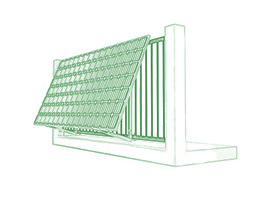
Recently, we had an interesting discussion with a customer in Canada about the material selection for solar plastic ballast blocks.
Their concern was understandable:
With temperatures ranging from -40°C to +50°C, how can we ensure the long-term durability of plastic ballast systems?
Should we choose HDPE instead of PP?
Both materials have their advantages, but the comparison goes beyond their names.
Here are a few things worth considering:
PP (Polypropylene)
Generally lighter and stiffer, PP helps maintain the shape and dimensional stability of the ballast.
However, standard PP grades may become more susceptible to cracking under impact at very low temperatures.
HDPE (High-Density Polyethylene)
HDPE generally offers better low-temperature toughness and impact resistance, making it a promising option for cold-climate applications.
On the other hand, it is typically more flexible, so its deformation under long-term loading also needs to be evaluated.
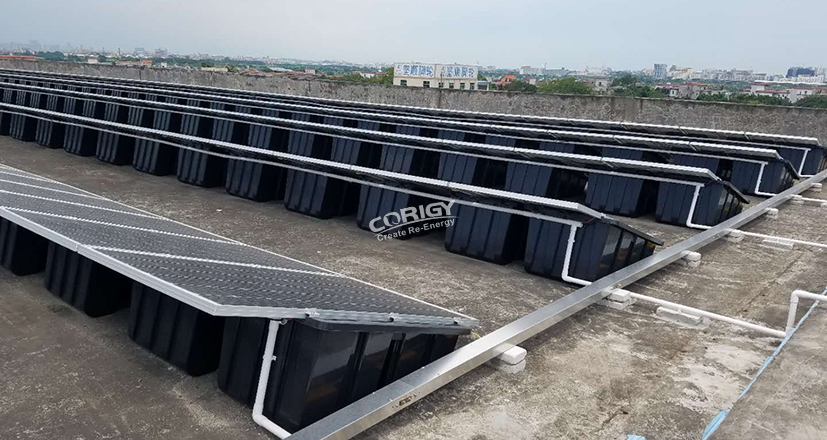
But here's something we shouldn't overlook:
Low-temperature performance is not determined by the base material alone.
The specific resin grade, additives, formulation, product geometry, and manufacturing process all play important roles.
For example, impact modifiers such as POE can improve the toughness of PP, although the actual improvement depends on the formulation and should be verified through testing.
At Corigy, our regular solar plastic ballast products are manufactured using PP. We can also manufacture HDPE ballast products based on specific project requirements.
Rather than recommending one material for every situation, we believe the right approach is to understand the operating environment, evaluate the material options, and verify the finished product's performance.
The best material isn't necessarily the one with the best individual properties. It's the one that delivers the right balance of performance, durability, and reliability for the actual application.
What's your experience with PP and HDPE in outdoor applications, especially in cold climates?
I'd be interested to hear your thoughts.
Corigy Solar Ground Mounting Racking System Structure is widely applied for landfll, open space or sloping terrain, etc, Diferent kinds of material can be offered for any needs, such as galvanized steel, anodized aluminum and ZAM materials.
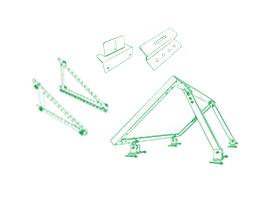
Flat roof solar mounting systems offer robust support and easy installation for solar panels on flat roofs. These systems ensure maximum energy capture, durability, and cost-efficiency, making them ideal for residential and commercial properties. Corigy flat roof solar panel mounting system, such as ballast mount, east-west ballast mount, etc. Contact us to learn more!
Install solar panel on the metal roof by standing seam, klip-lok, L foot or other clamps.
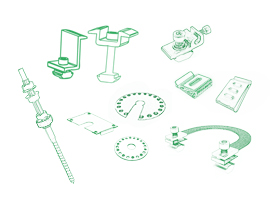
Solar mounting accessories such as end/mid clamp, cable clip, grounding items, etc.

CORIGY SOLAR, 15 years experience of research, manufacture and sale of solar energy system. We are always trying to provide the best support for you, including fast response, cost, QC, design, distributor support.
Phone
0086-592-6883200Location
No.893,Haicang Avenue,Haicang District,Xiamen City,China.

 IPv6 network supported
 English
 español
 한국의