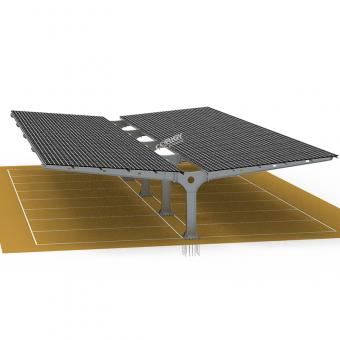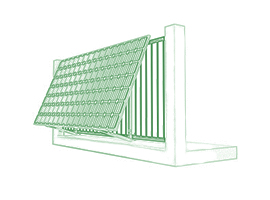
The material of the supporting structure of a photovoltaic carport directly determines its service life, load-bearing capacity, maintenance cost and applicable scenarios. Carbon steel and aluminum alloy are the two most mainstream materials on the current market, with significant differences in performance, cost, environmental protection and other dimensions. The following is a detailed summary of their respective advantages and disadvantages to provide a reference for material selection.
I. Carbon Steel Photovoltaic Carport
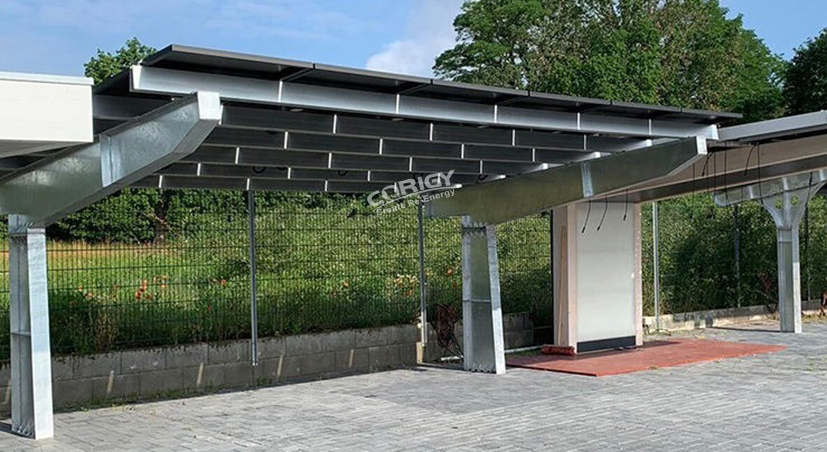
Carbon steel photovoltaic carports mainly adopt carbon steel grades such as Q235B and Q355B as the core support materials, which are usually treated with anti-corrosion processes including hot-dip galvanizing, cold galvanizing or spraying. They are the mainstream choice for industrial areas, large parks and other scenarios, occupying about 75%-80% of the market share, with core advantages in structural strength and cost performance.
Advantages
High load-bearing capacity and outstanding span performance. Carbon steel features high yield strength (approximately 235MPa for Q235 and 355MPa for Q355), with tensile strength ranging from 400MPa to 550MPa, far exceeding that of aluminum alloy. A single steel column can bear a load of over 500kg, enabling a large-span design of more than 12 meters without excessive intermediate columns. It saves site space and is compatible with heavy-duty photovoltaic modules, suitable for large-area solar panel arrangement to improve power generation efficiency and land utilization rate. Some products can withstand wind speeds up to 60m/s, reaching a wind resistance grade of Level 10 to 12, and deliver strong snow load resistance, meeting the application demands of snowy regions in northern China.
Low cost and superior cost performance. The raw material price of carbon steel is only 1/3 to 1/2 of that of aluminum alloy. With mature rolling, welding and other processing technologies, component costs are low in mass production. The overall cost of the support system is about $11.5–21.4 per square meter, which greatly reduces the initial investment of photovoltaic carport projects. It is especially suitable for large-scale and cost-sensitive projects, such as industrial logistics parks and desert photovoltaic carport projects.
Flexible processing and high customization. Carbon steel has excellent welding performance. Special-shaped components (such as long-span beams and corner brackets) can be customized according to site requirements, adapting to complex terrain such as mountains and sloped land. It can also be flexibly matched with concrete foundations and other metal materials, delivering strong construction adaptability.
Disadvantages
Poor corrosion resistance and regular maintenance required. Carbon steel is prone to oxidation and rusting by nature. Even with hot-dip galvanizing (zinc coating thickness ≥ 85μm) or surface spraying treatment, rusting issues still easily occur in harsh environments with high humidity, coastal salt spray, chemical dust and other corrosive factors. Anti-corrosion paint repainting is required every two years in coastal areas, and welding joints need annual inspection in ordinary humid regions, resulting in high long-term maintenance costs. Improper maintenance will greatly shorten the service life, with a designed service life of about 15 to 20 years under non-extreme environments.
Heavy self-weight increases construction and foundation costs. The density of carbon steel is about 7.85g/cm³, nearly three times that of aluminum alloy. The heavy overall structure raises transportation costs and requires more robust foundations (such as thickened concrete bases) for load bearing. More labor and resources are required during construction, leading to poor adaptability in scenarios with limited load-bearing capacity, such as rooftops and old sites.
Ordinary appearance with limited application scenarios. Carbon steel surfaces are mostly finished with galvanizing or spraying, with visible welding marks and a rough texture without obvious metallic luster. It cannot meet the high landscape and aesthetic requirements of office buildings, villa communities, high-end commercial complexes and other premium scenarios.
II. Aluminum Alloy Photovoltaic Carport
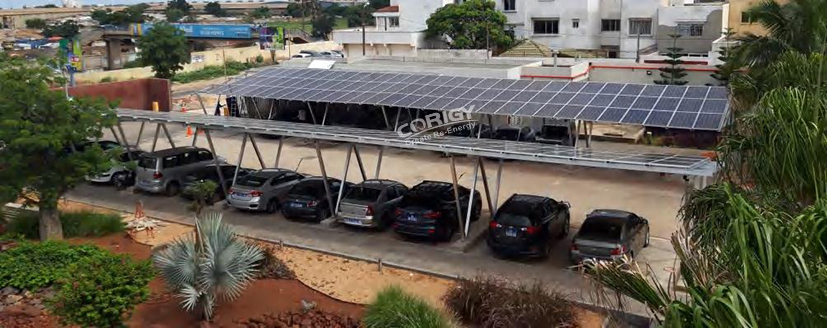
Aluminum alloy photovoltaic carports are mainly made of grades such as 6061-T6 and 6063-T5. With surface treatments including anodizing or fluorocarbon spraying, they feature light weight and excellent corrosion resistance. They are increasingly widely used in high-end projects and coastal areas, accounting for about 15%–20% of the market share, with a growth rate higher than carbon steel carports.
Advantages
Excellent corrosion resistance & low maintenance cost. A dense protective oxide film naturally forms on the aluminum alloy surface, eliminating the need for complex anti-corrosion treatment. It reaches a salt spray resistance grade above C5-M. In harsh environments such as coastal areas, rainy climates and high-humidity regions, no obvious rust occurs even after 10 years of service. Regular repainting of anti-corrosion coating is unnecessary, and only simple cleaning is required in later operation, leading to extremely low maintenance costs. Its design lifespan reaches 20–25 years, basically matching the 25–30 year service life of photovoltaic systems.
Lightweight design & convenient construction. The density of aluminum alloy is only 2.7g/cm3, roughly one-third of carbon steel. The lightweight structure reduces transportation costs by 30% compared with carbon steel. No heavy construction equipment is required; bolted connection (no on-site welding) and modular installation greatly improve efficiency and shorten the construction period. It is highly suitable for rooftops, old communities, narrow sites and other areas with limited load-bearing capacity or restricted large machinery access.
Premium appearance & high-end compatibility. Anodized aluminum alloy presents a sleek metallic texture with no welding marks. Custom color spraying is available to perfectly integrate with architectural landscapes. It is ideal for office buildings, villa communities, commercial complexes and other projects with high aesthetic requirements, greatly enhancing the overall visual effect.
Eco-friendly & high recycling value. Aluminum alloy follows a high upfront, low long-term carbon emission model. Though carbon emissions are high during raw material production, recycled aluminum only consumes about 5% of the energy required for primary aluminum production, with a recycling rate of over 90%. It helps gain credits in green building certifications such as LEED and BREEAM, complies with dual-carbon strategic goals, and delivers outstanding long-term environmental benefits.
Disadvantages
Limited load-bearing capacity & span. The tensile strength of aluminum alloy is only 200–300MPa, far lower than carbon steel. The load capacity of a single aluminum column is ≤ 300 kg, and the maximum span is limited to 8 meters. It cannot support spans over 12 meters or heavy-duty photovoltaic modules, making it unable to meet the large-span and high-load demands of industrial parks, large parking lots and similar facilities.
High cost & large initial investment. Aluminum alloy raw materials are expensive, and its processing is more complex than carbon steel. The overall cost of the support system (including structural parts and drainage systems) is about $28.5–50 per square meter, 2 to 3 times that of carbon steel carports. The high initial investment results in poor cost performance for budget-limited projects.
Difficult processing & limited customization. Aluminum alloy has poor weldability and is not suitable for special-shaped processing. It mostly adopts standardized component assembly, which struggles to adapt to complex terrain or special size requirements. Customization involves higher costs, longer lead times and lower flexibility compared with carbon steel.
Weak impact resistance.Aluminum alloy is relatively brittle with inferior bending and impact resistance. It is prone to permanent deformation and damage under external force such as vehicle collision. Repair work is difficult, and overall component replacement is usually required.
Carbon steel photovoltaic carports feature high cost performance, strong load-bearing capacity and wide adaptability, making them the preferred choice for large-scale, budget-sensitive projects in inland dry regions with large-span demands, such as industrial logistics parks and desert photovoltaic parking systems.
Aluminum alloy photovoltaic carports focus on light weight, superior corrosion resistance and high aesthetics, suitable for well-funded projects with strict requirements on appearance and low maintenance, especially in coastal areas and high-end scenarios including commercial complexes and residential villa communities.
Material selection shall be comprehensively determined by site environment, load-bearing requirements, budget and environmental goals, to strike an optimal balance between practicality and economic efficiency.
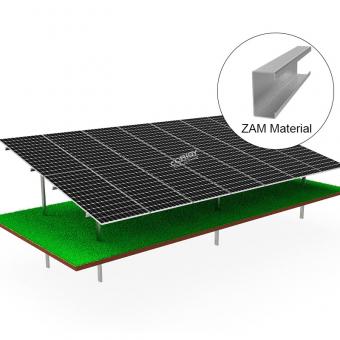
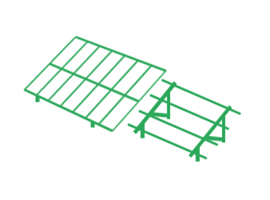
Corigy Solar Ground Mounting Racking System Structure is widely applied for landfll, open space or sloping terrain, etc, Diferent kinds of material can be offered for any needs, such as galvanized steel, anodized aluminum and ZAM materials.
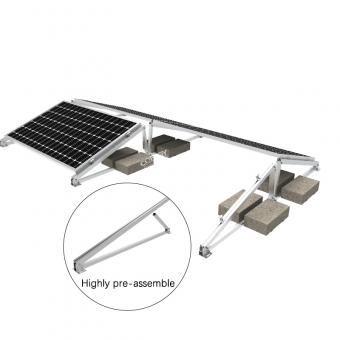
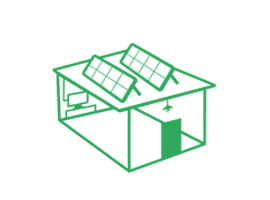
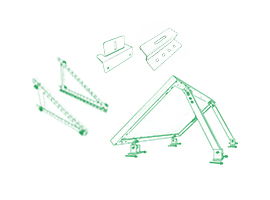
Flat roof solar mounting systems offer robust support and easy installation for solar panels on flat roofs. These systems ensure maximum energy capture, durability, and cost-efficiency, making them ideal for residential and commercial properties. Corigy flat roof solar panel mounting system, such as ballast mount, east-west ballast mount, etc. Contact us to learn more!
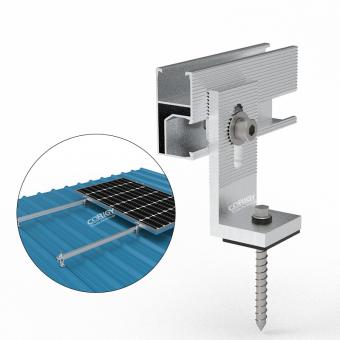
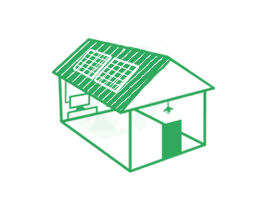
Install solar panel on the metal roof by standing seam, klip-lok, L foot or other clamps.
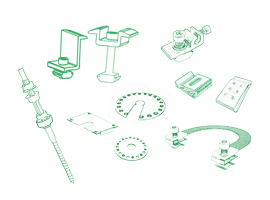
Solar mounting accessories such as end/mid clamp, cable clip, grounding items, etc.

CORIGY SOLAR, 15 years experience of research, manufacture and sale of solar energy system. We are always trying to provide the best support for you, including fast response, cost, QC, design, distributor support.
Phone
0086-592-6883200Location
No.893,Haicang Avenue,Haicang District,Xiamen City,China.

 IPv6 network supported
 English
 español
 한국의
한국의