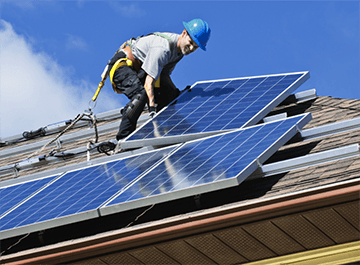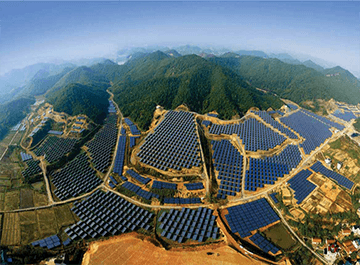
Solar panel maker ARTsolar has filed a petition with the International Trade Administration Commission of South Africa, seeking customs tariffs on all imported crystalline silicon PV panels. In the document, submitted at the end of March, the manufacturer complained there was no protection for module manufacturers in the country, as existed in the U.S. and Europe, although in the latter case trade measures were lifted last year. “A number of photovoltaic module/panel manufacturers had ceased their production operations in the SACU region due to high competition from low-priced imports,” the petitioner wrote, in reference to the Southern African Customs Union area which also includes Botswana, Lesotho, Namibia and Eswatini. Rising costs Andy Pegg, CEO of the SegenSolar (Pty) Ltd South African subsidiary of U.K. solar distributor Segen Ltd, said the introduction of import tariffs could see the price of PV modules rise by 10% overnight in South Africa. “The 10% tariff will, ultimately, be passed down to the customer or installer in the form of increased product prices – which could see demand plummet and profit margins squeezed, particularly for smaller distributors,” he told pv magazine. Pegg added, the major problem with tariffs in South Africa would be the lack of government support for the sector. For tariffs to be effective, he said, the policy and regulatory environment must support the growth and supply of the renewables sector. “For example, China has seen explosive growth in solar PV power generation due to continually adjusting its solar energy targets upward in line with demand – which increased from 10% in 2012 to 55% in 2017,” he said. It’s all about Eskom Pegg also highlighted the operational and financial problems of state-owned utility Eskom as a handicap to the country’s energy sector. Last month, Eskom required an emergency $355 million bailout to prevent a debt default when it was already struggling to fix crippling power shortages. Media reports claimed the utility also failed to receive ZAR7 billion ($485 million) in loan payments from the Chinese Development Bank this month. “It seems more likely the proposed import tariffs would make it explicitly easier for the state-owned Eskom to keep its monopoly on energy supply in South Africa,” Pegg said. Chris Ahlfeldt, energy specialist at Blue Horizon Energy Consulting Services, said tariffs would probably have a net negative impact on jobs for the domestic solar industry, adding they would slow down customer adoption through higher prices. “Solar PV installers create many more local jobs than the manufacturing industry globally, so the focus should be on accelerating growth in the industry as a whole to create jobs and not slowing it down with tariffs,” he said to pv magazine. ‘Incentives, not penalties’ According to Ahlfeldt, the best way to incentivize localization of industry is by creating stable demand. Rather than introducing tariffs, he said, the government should focus ...
Read MoreFrom pv magazine Germany. Germany’s Federal Network Agency, the Bundesnetzagentur, has reported newly installed PV capacity of approximately 349.5 MW for March. Of that capacity, 334 MW were installed under the country’s FIT mechanism. The Bonn-based Bundesnetzagentur reported 28 MW of ground-mounted systems were built in March outside the tender scheme. A meager 868 kW of rooftop system capacity was installed under the tenant electricity scheme. Overall, around 1.27 GW of new PV capacity was added in Germany in the first three months of the year, even with the Bundesnetzagentur revising down its January and February figures by 40 MW each, to 540 MW and 380 MW, respectively. An agency spokesperson told pv magazine the figures are regularly adjusted retrospectively. The revised statistics mean Germany reached a cumulative solar capacity of just short of 47.2 GW by the end of March. The Bundesnetzagentur has recalculated the level of FIT payment for the next three months, with the payment falling as installation milestones are reached. Larger-than-expected levels of new installations in the first quarter mean the FIT will reduce by 1.4% from this month until July. The feed-in tariff for PV systems with a capacity of up to 10 kW will fall to €0.1095/kWh. For systems up to 40 kW the payment will be €0.1065/kWh and for systems up to 100 kW, €0.0838/kWh. Other plants with a capacity of up to 100 kW will receive a fixed €0.0759/kWh.
Read MoreThe World Bank has launched a new program to accelerate the uptake of sustainable cooling solutions such as air conditioning, refrigeration and cold chain in developing countries. The program will mobilize further financing and provide technical assistance to ensure that efficient cooling is included in new World Bank investment projects. It will help countries develop the necessary market infrastructure, financing mechanisms, policies and regulations to deploy sustainable cooling at scale. Another area of focus will include working with partners in the public and private sectors to raise awareness about efficient, clean cooling opportunities in emerging markets. The World Bank’s Energy Sector Management Assistance Program (ESMAP) has received a $3 million grant for the program from the Kigali Cooling Efficiency Program (K-CEP), which helps countries increase the energy efficiency of cooling solutions. “Efficient, clean cooling can contribute significantly to a stable climate and cut energy costs at the same time. However, financing is needed to cover the capital costs of cooling technology, especially in developing countries. That is why K-CEP is excited to partner with the World Bank to mobilize the investments required to make cooling for all a reality,” said Dan Hamza-Goodacre, K-CEP’s executive director. The World Bank will mobilize its expertise across sectors such as transport, energy and agriculture. With International Finance Corp. (IFC), it will also lay the groundwork for a pipeline of new projects that could either be supported by the World Bank Group or rely on other sources of financing. Energy use for cooling set to triple Global demand for cooling is increasing, mainly driven by growing populations, urbanization and rising income levels in developing countries. Rising temperatures will further exacerbate this issue by increasing demand for cooling appliances, which use large amounts of energy and leak refrigerants that contribute to global warming. By 2050, energy use for cooling is projected to triple, while estimates show that demand for cooling in countries in the tropics and subtropics such as India, China, Brazil, and Indonesia will grow fivefold, which will put pressure on already strained energy systems and hamper efforts to curb climate change. Sustainable cooling central to energy transition “Sustainable cooling is a fundamental part of the energy transition. Meeting the growing demand for cooling services without compromising climate change goals will require substantial investments in energy efficient cooling solutions that are affordable and accessible to developing countries,” said Rohit Khanna, manager of the energy sector management assistance program at the World Bank. “This is exactly what the new program is set to do and as such, it will underpin the World Bank’s longer-term strategy on sustainable cooling.” Marc Sadler, practice manager of the World Bank’s Climate Funds Management Unit, said a sustainable a...
Read MoreThe latest new solar capacity figures to emerge from China have painted an even grimmer picture than previously thought as a continuing national PV policy vacuum keeps the utility scale segment of the world’s biggest solar marketplace in the doldrums. Days after Californian investment bank Roth Capital Partners reported 4.6 GW of new solar capacity was added in January and February – 3.4 GW and 1.2 GW, respectively – a Chinese consultancy has quoted an official as reporting even lower figures. The Asia Europe Clean Energy (Solar) Advisory Co Ltd (AECEA) has reported just 5.2 GW of new PV capacity was added in the first quarter of this year, and added, China’s Electricity Council reported last month just 3.49 GW had been installed in January and February. The 5.2 GW, first-quarter figure reportedly came from an official of China’s National Renewable Energy Agency and is the latest detail to leak from weeks of policy negotiations being held in Beijing between government organizations and solar industry stakeholders. Project numbers almost halved The AECEA this morning reported the 5.2 GW of new solar added in the first three months of the year represented a 46% drop on the same period last year – during a solar boom abruptly curtailed by the Chinese government at the end of May due to a rising solar subsidy debt pile owed by the state to project developers. The consultancy said the most alarming revelation about the January to April figures was that this year’s new installations were virtually all small scale, distributed generation projects because larger projects have ground to a halt since that policy about-turn last year. The AECEA says the ongoing Beijing negotiations – despite last week producing two consultancy papers hinting at a proposed path to subsidy-free solar in China – may not become official policy until early or mid June. Deadline looming Roth Capital, in its analysis, said staying on track for an expected 40 GW of new solar in China this year would hinge on whether the National Energy Administration was able to publish details of projects approved for subsidies by the end of June. Given last Wednesday’s consultation paper about subsidy-free project approvals stipulated details of such facilities would have to be submitted to central authorities by next Thursday, the timing looks off and may set alarm bells ringing in the boardrooms of manufacturers such as Longi, Daqo and GCL Poly who are currently breaking the bank to expand their production capacities. Despite the disappointing figures, however, the AECEA maintained its prediction China will install 35-40 GW of new capacity this year.
Read MoreVictoria has turned to the Clean Energy Council (CEC) in an attempt to ensure that householders looking to install PV under its A$1.3 billion ($921.9 million) Solar Homes program avoid dodgy solar systems and operators. The government says that the move will ensure that installers who can carry out subsidized installations “meet the highest safety and quality standards.” Two deadlines have been set for PV retailers and installers to become CEC Approved Solar Retailers. “Major solar retailers,” according to the government’s announcement today, have until July 1 to pass the CEC’s approval process, while “all other retailers” have until November – presumably smaller installation operations. In a statement, Victorian Energy and Solar Homes Minister Lily D’Ambrosio said that “safety and quality” is primary concern of the government: “We won’t cut corners in rolling out this landmark package – we’re giving Victorians the support they need to take part and take back control of their energy costs.” She added that the CEC’s installer Code of Conduct will allow it easier for installers and customers to understand, “what they’re entitled to”. The Solar Homes program provides a subsidy of up to $2250 for a residential PV installation. It targets PV installations at 700,000 homes, including 50,000 rentals, and 10,000 solar battery installations over 10 years. The CEC reports that 250 retailers and installers are already qualified under the program. But the Smart Energy Council (SEC) is annoyed at the Victorian decision. “It’s extremely disappointing,” says the Smart Energy Council’s Government Relations Manager Wayne Smith. “We believe that the CEC code and the action from the Victorian government is anti-competitive. It will disadvantage a significant number of solar companies and solar workers in Victoria. We are concerned that it seems to undermine the work that so many industry groups have done to develop and industry wide code of conduct for the solar and storage industry.” The SEC reports that a second “industry wide” code was in the process of being developed in partnership with a number of industry and consumer groups. “It is our clear view that the CEC Code of Conduct is not fit-for-purpose, and that’s why a new industry wide Code of Conduct is being developed,” says Smith. He suggested that the CEC code could “lock in” the advantage enjoyed by larger retailers over smaller installers. Both South Australia and Queensland require installers to sign up to the CEC code.
Read MoreIn the fourth quarter of 2018, JinkoSolar broke its own record for quarterly module shipments, sending out 3.6 GW, a 22.5% increase on the previous quarter. This closed out a year where the manufacturer shipped a total of 11.4 GW of modules — including 209 MW shipped to its own downstream projects — a 16% increase over the 9.8 GW shipped in 2017. Despite the increase in shipments, Jinko’s revenue for the full year fell by 5.4%, coming in at $3.64 billion — a sign of the times in a year where module prices fell by around 30%. Jinko says that its global reach was key to weathering the storm caused by China’s 31/5 policy shift. “While the Chinese market was impacted by the policies released on May 31, we were able to continue growing through our diversified global distribution network and further consolidate our leading position in terms of market share,” commented JinkoSolar CEO Kangping Chen. And the company expects to almost double its shipment growth this year. It has posted guidance for first quarter shipments in 2019 to fall slightly over the previous quarter to between 2.8 and 3 GW, but full-year shipments are forecast at 14 to 15 GW, which would represent around a 30% increase over 2018’s full-year figure. Behind this prediction is a belief that growth will return to China in 2019, as the country shifts its policy from feed-in tariffs to a bidding system for utility-scale projects, and finds a solution to the problem of delayed payments. “The new policies set a clear direction for the country’s solar plans and will help to greatly improve sentiment for the solar sector as the country tries to smoothly transition towards grid parity and encourage a more market-driven environment,” continued Chen. “Based on the new policies, we believe domestic installations in 2019 will exceed last year. Distributed generation projects and projects completed at grid parity will continue to make up a larger portion of overall installations.” Elsewhere, JinkoSolar has high expectations for the U.S. market this year, and says that its new factory in Jacksonville, Florida, will reach its full production capacity in the second quarter. And with the minimum import price gone and forgotten, Europe will again be a key target for Jinko’s products. Cost optimization On the technology side, Jinko says it will expand its monocrystalline wafer production this year and continue to reduce its manufacturing costs at this level through optimizing its use of large-scale crystalline furnaces and reducing diamond wire consumption in cutting. The company is also planning to convert its existing non-PERC capacity to produce PERC products this year, alongside significant capacity expansions. At the end of 2018, the company’s production capacity stood at 9.7 GW for silicon wafers, 7 GW for cells and 10.8 GW for modules. By the end of 2019, it says it expects these to reach 15 GW for wafers, 11 GW of which would be monocrystalline, 10 GW for cells, 9.2 GW of which will be PERC, ...
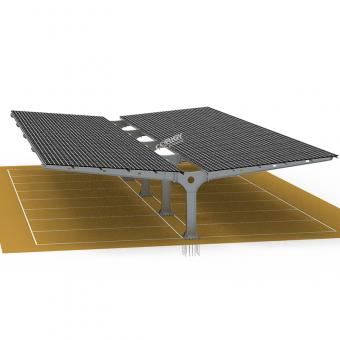
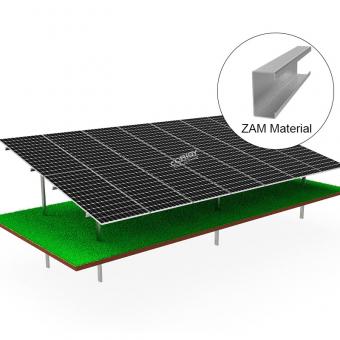
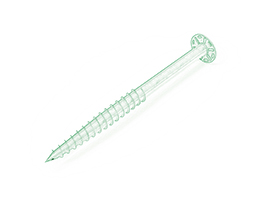
Read MoreCorigy Solar Ground Mounting Racking System Structure is widely applied for landfll, open space or sloping terrain, etc, Diferent kinds of material can be offered for any needs, such as galvanized steel, anodized aluminum and ZAM materials.
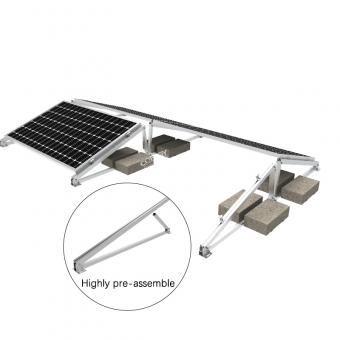
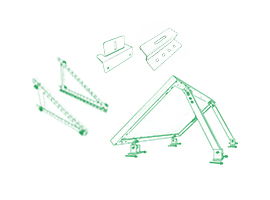
Flat roof solar mounting systems offer robust support and easy installation for solar panels on flat roofs. These systems ensure maximum energy capture, durability, and cost-efficiency, making them ideal for residential and commercial properties. Corigy flat roof solar panel mounting system, such as ballast mount, east-west ballast mount, etc. Contact us to learn more!
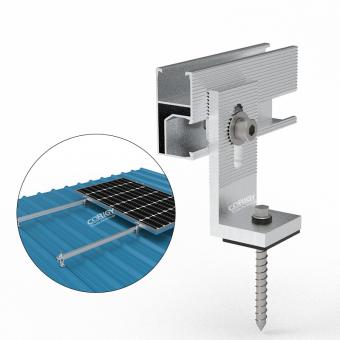
Install solar panel on the metal roof by standing seam, klip-lok, L foot or other clamps.
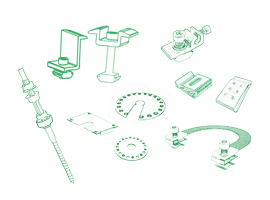
Solar mounting accessories such as end/mid clamp, cable clip, grounding items, etc.

CORIGY SOLAR, 15 years experience of research, manufacture and sale of solar energy system. We are always trying to provide the best support for you, including fast response, cost, QC, design, distributor support.
Phone
0086-592-6883200Location
No.893,Haicang Avenue,Haicang District,Xiamen City,China.

 IPv6 network supported
 English
 español
 한국의
한국의