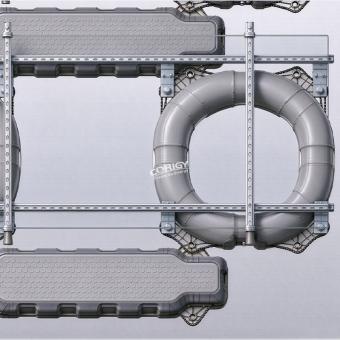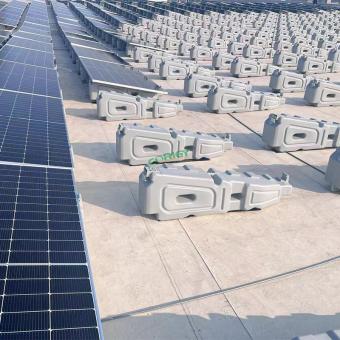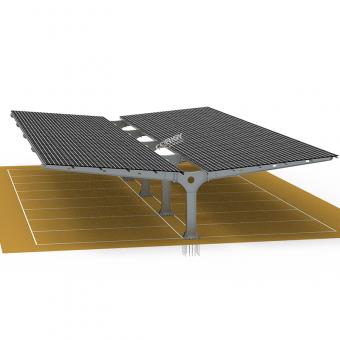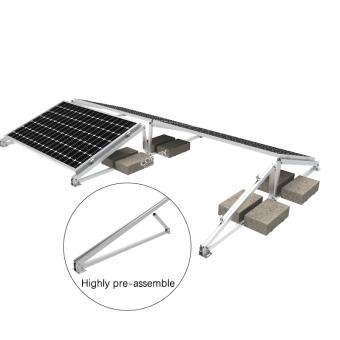
The plastic solar ballast is widely used in the distributed photovoltaic market in multiple overseas countries, especially suitable for industrial and commercial roof scenarios with limited roof bearing capacity and no drilling through the roof. It is one of the mainstream forms of no drill solar panel roof mounts, and its application continues to increase in projects in Europe, America, Southeast Asia, and other regions.
People would wonder why choose plastic ballast? Its unique advantages make consumers favor this solution.
1. The plastic ballast is one of no drill solar panel roof mounts, and this solar panel support brackets does not require damage to the roof waterproof layer, greatly reducing the risk of roof leakage and suitable for various flat roofs.
2. The plastic solar ballast is one of the most convenient PV mounting options. Thanks to its integrated design, there is no need for assembly, on-site welding or drilling operations. The technical requirements for the installation team and workers are also relatively low. Fast installation speed can greatly reduce labor costs.
3. This plastic ballast solution can also be flexibly disassembled and moved after installing modules. It is relatively convenient to adjust the layout of modules and relocate the power station, and the change process will not leave permanent damage marks on the roof or floor.
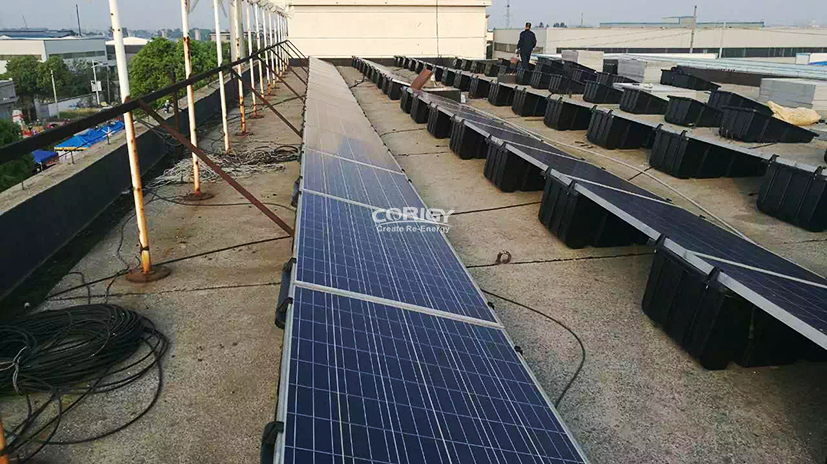
However, it also has inherent disadvantages: the wind resistance of plastic pressure is limited by weight. In areas with strong winds, even with an increase in weight, it may not be able to withstand the maximum wind speed. In addition, when plastic materials are exposed to long-term outdoor sunlight, it may cause aging, fading, and deformation of the solar panel support brackets. Therefore, high UV resistant materials need to be selected to ensure the service life. Compared with the aluminum alloy and steel solutions, under the same wind conditions and site area, the number of PV modules placed is less; And the plastic solar ballast solution has certain requirements for the flatness of the roof and installation site, which require the slope should be within in a certain scope.
Of course, even though plastic solar ballast compression carries the aforementioned disadvantages, its advantages are still very obvious when facing scenarios that require flexible disassembly and not damaging requirement. For small-scale photovoltaic projects, consumers can consider using this solution.
CORIGY also has plastic solar ballast of different specifications. If you have any needs, contact CORIGY to learn more about it.
Corigy Solar Ground Mounting Racking System Structure is widely applied for landfll, open space or sloping terrain, etc, Diferent kinds of material can be offered for any needs, such as galvanized steel, anodized aluminum and ZAM materials.
Flat roof solar mounting systems offer robust support and easy installation for solar panels on flat roofs. These systems ensure maximum energy capture, durability, and cost-efficiency, making them ideal for residential and commercial properties. Corigy flat roof solar panel mounting system, such as ballast mount, east-west ballast mount, etc. Contact us to learn more!
Install solar panel on the metal roof by standing seam, klip-lok, L foot or other clamps.
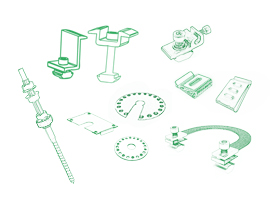
Solar mounting accessories such as end/mid clamp, cable clip, grounding items, etc.

CORIGY SOLAR, 15 years experience of research, manufacture and sale of solar energy system. We are always trying to provide the best support for you, including fast response, cost, QC, design, distributor support.
Phone
0086-592-6883200Location
No.893,Haicang Avenue,Haicang District,Xiamen City,China.

 IPv6 network supported
 English
 español
 한국의